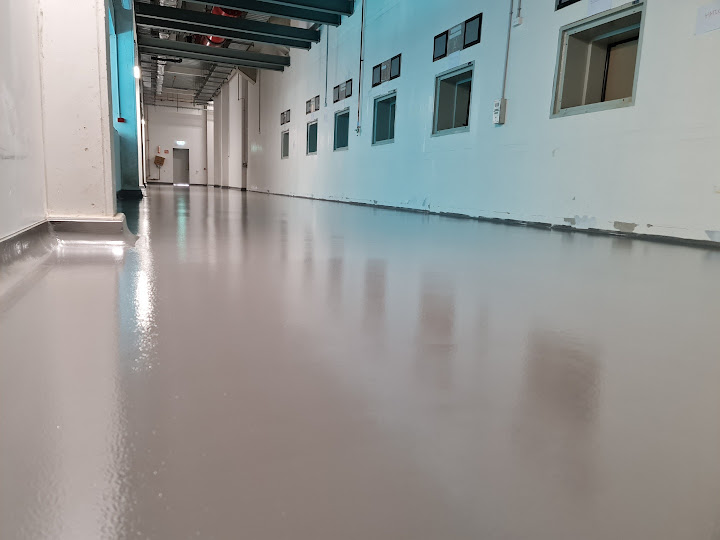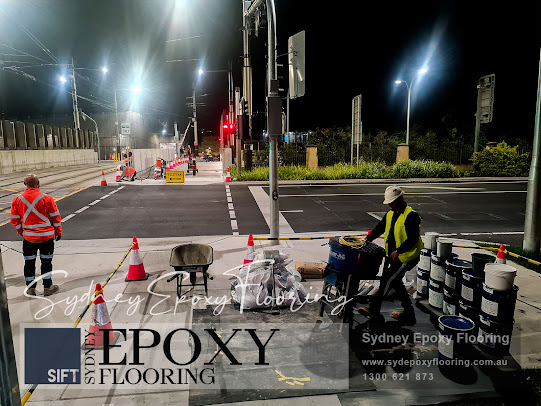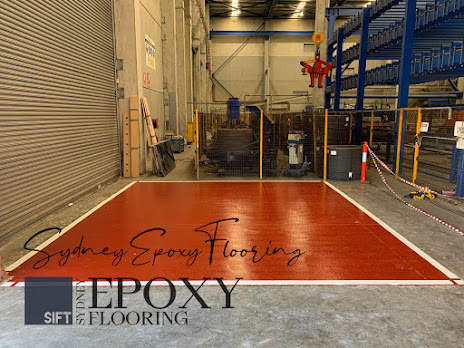
Warehouse Safety & Efficiency Improvement with Professional Epoxy Line Marking Service in Sydney is no longer a nice-to-have — it is a legal and operational necessity for any business running a commercial facility. If your warehouse floor lacks clear markings, you are exposing your team to avoidable risk, inviting compliance failures, and quietly draining productivity every single shift.
Commercial Kitchen Waterproofing Services shares a core principle with line marking: protection through intelligent barrier systems. But for warehouses, distribution centres, and industrial sites across Sydney, the most visible floor safety investment you can make is professional epoxy line marking. It defines pedestrian zones, separates forklifts from foot traffic, marks emergency exits, and signals hazard areas. Without it, your site is a WorkSafe liability waiting to happen.
This guide covers why line marking matters, what problems arise without it, how professional epoxy systems outperform paint, and why Sydney Epoxy Flooring is the team Sydney operators trust. Whether you manage a warehouse in Wetherill Park, a cold storage facility in Eastern Creek, or a logistics hub in Prestons, this is written for you.
HIGHLIGHT: Safe Work Australia reports that slips, trips, and vehicle-pedestrian collisions are among the top causes of serious workplace injuries in warehouses. Proper floor line marking, especially with durable epoxy, directly reduces these incidents and keeps your facility WHS-compliant.
Understanding Epoxy: What It Is and Why It Behaves Differently
Not all floor marking materials are equal. To make an informed decision about your warehouse floor, it helps to understand what epoxy actually is at a material level.
What is epoxy?
Epoxy is a thermosetting polymer created through a chemical reaction between two components: a resin and a hardener. When these two components are combined in the correct ratio and applied to a properly prepared concrete surface, they undergo an irreversible curing process. Unlike standard floor paint, which dries through evaporation of solvents, epoxy cures through chemical cross-linking, forming a rigid, dense molecular network that bonds to the concrete substrate rather than simply sitting on top of it.
This distinction matters enormously in industrial environments.
Two-component (2K) vs one-component epoxy
Most professional-grade line marking systems use two-component (2K) epoxy. These systems require on-site mixing immediately before application and offer significantly superior performance compared to single-component products. Two-component systems achieve higher bond strength, better chemical resistance, and much greater hardness — all of which matter when forklift tyres are crossing the same line hundreds of times per day.
Single-component epoxy products, sometimes sold in hardware stores as DIY solutions, behave more like modified paints. They are easier to apply but do not achieve the same molecular density or adhesion depth. In a high-traffic industrial environment, the performance gap becomes visible within weeks.
Hardness and abrasion resistance
Industrial epoxy systems are measured against standards for Shore D hardness and abrasion resistance (often tested against the Taber Abraser standard). A properly formulated two-component epoxy floor coating can achieve Shore D hardness of 75–85, making it far more resistant to the rubber tyre abrasion, chemical exposure, and mechanical impact typical of busy warehouse floors.
VOCs and indoor air quality
Modern water-based epoxy formulations have significantly reduced Volatile Organic Compound (VOC) emissions compared to solvent-based systems used in earlier decades. For enclosed warehouse environments with workers present, this matters from a health perspective. Professional applicators working with higher-solvent systems are required under WHS regulations to ensure adequate ventilation and use appropriate respiratory protection during application.
Epoxy Line Marking Service-Related Common Problems People Face
Why Is Epoxy Line Marking Important for Warehouse Safety?
Without clear floor markings, workers and forklift operators share undefined space — a collision risk that costs lives and triggers compensation claims. Most warehouse injuries happen because there are no visible boundaries separating vehicle lanes from pedestrian walkways. Operators rely on eye contact and guesswork, which fails under pressure or when new staff are on site.
Warehouse Safety & Efficiency Improvement with Professional Epoxy Line Marking Service in Sydney solves this by creating permanently visible, colour-coded zones. Epoxy chemically bonds to concrete, producing lines that do not fade under constant traffic. AS/NZS 4602 and WHS regulations require clearly marked emergency exits, hazard zones, and pedestrian lanes — and industrial-grade epoxy delivers exactly that. With 12+ years of experience and over 2,000 projects completed, Sydney Epoxy Flooring has transformed dozens of chaotic warehouse floors into safe, structured environments.
How Does Professional Line Marking Improve Warehouse Efficiency?
Disorganised floors waste time. Workers hunt for picking zones. Forklifts take inefficient routes. Stockpiles up in undefined areas. This productivity drain is constant but rarely tracked — until you put numbers to it.
Warehouse Safety & Efficiency Improvement with Professional Epoxy Line Marking Service in Sydney directly addresses this by defining clear traffic flows, storage grids, and work zones. This cuts movement waste and reduces operator decision time on the floor. Sydney Epoxy Flooring designs custom line marking layouts based on your specific workflow — not a generic template. Our team has helped distribution centres in Western Sydney restructure floor layouts using colour-coded epoxy zones, resulting in measurably faster pick-and-pack cycles.
What Types of Areas Require Line Marking in a Warehouse?
Many operators underestimate how much of their facility needs marking. It is not just the main floor. Loading docks, racking aisles, coolroom approaches, emergency exit paths, fire extinguisher stations, first aid points, EV charging bays, and pedestrian crossings all require clearly defined markings under Australian WHS law.
Commercial Kitchen Waterproofing Services and line marking share one principle: comprehensive coverage matters. Just as waterproofing must cover every surface that contacts moisture, line marking must cover every zone where movement occurs. Our Epoxy Line Marking Service in Sydney covers all facility areas in a single mobilisation — minimising downtime and ensuring complete compliance from day one.
Can Epoxy Line Marking Withstand Heavy Industrial Traffic?
Standard floor paint fails fast. A painted line in a busy warehouse aisle can fade within weeks under forklift tyres. When markings disappear, safety disappears with them — and you are back to repainting at recurring cost.
Epoxy is a different product entirely. It chemically bonds to concrete, creating a surface that handles heavy machinery, chemical spills, and constant rubber tyre contact without degrading. Sydney Epoxy Flooring uses only industrial-grade, two-component epoxy systems sourced from top-tier suppliers. Our line marking in warehouses across Blacktown, Rydalmere, and Ingleburn has remained fully intact years after application — no fading, no peeling, no compromised safety.
How Often Should Warehouse Line Markings Be Refreshed or Maintained?
This is where most operators get caught off guard. They assume markings are permanent. Paint-based systems need refreshing every 6–12 months. Even some lower-grade epoxy products degrade faster than expected in high-traffic zones.
Professional Epoxy Line Marking Service in Sydney, applied correctly with proper surface preparation, typically lasts 5–10 years before any refresh is needed. Sydney Epoxy Flooring’s process includes diamond grinding for surface prep, priming, and multi-coat application — which is why our markings outlast the competition. We also offer scheduled visual assessments so your lines stay sharp and compliant without requiring you to manage it manually.
WARNING: Non-compliant floor markings can result in WorkSafe NSW penalties, increased workers’ compensation premiums, and potential site shutdown during audits. Do not wait for an incident to trigger a review. Act before the inspector does.
Professional Epoxy vs. DIY Line Marking: At a Glance
| Factor | DIY / Paint | Professional Epoxy Line Marking |
| Safety Compliance | Non-compliant | Fully AS/NZS compliant |
| Durability | Fades in weeks | Lasts 5–10 years |
| Downtime | Repeated repaints | Minimal — one application |
| Long-term Cost | Ongoing spend | Single strategic investment |
| Heavy Traffic | Wears quickly | Handles forklifts & machinery |
| Customisation | Limited | Full colour & symbol options |
PRO TIPS:
Always complete surface preparation (diamond grinding + crack repair) before application. Lines on dusty or damaged concrete fail early.
Use Australian colour standards — yellow for pedestrian zones, blue for information, red for hazard/no-go areas.
Schedule a visual check every 12 months even with professional epoxy — catching minor wear early keeps you compliant.
Combine line marking with non-slip epoxy coating in wet or high-traffic zones for maximum safety outcomes.
What Poor Surface Preparation Actually Causes, And Why It Matters
One of the most common reasons floor markings fail prematurely, regardless of product quality, is inadequate surface preparation before application.
Concrete is a porous material, but its surface condition varies considerably depending on age, construction method, and how it has been treated since installation. Many warehouse floors have been subjected to years of oil contamination, chemical spills, cleaning product residue, and the ghost outlines of previous paint or marking systems. All of this affects how well a new marking system will bond.
Diamond grinding: what it does and why it matters
Diamond grinding (also called mechanical scarification) uses rotating diamond-tipped abrasives to remove the surface laitance from concrete — the weak, fine-grained top layer that naturally forms during the curing process. This layer looks solid but has much lower strength and porosity than the concrete beneath it.
Removing this layer serves two purposes: it creates a clean, contamination-free surface, and it opens the pore structure of the concrete so that the primer and epoxy can penetrate and form a mechanical bond, not just a surface adhesion.
A floor marking system applied to unground concrete bonds only to that weak surface layer. When that layer eventually separates from the substrate under traffic stress — which it will — it takes the marking with it.
Crack and spall repair
Cracks and surface spalling in concrete must be addressed before marking application. Applying epoxy over an active crack simply transfers the stress concentration to the new coating, which will crack along the same line under thermal movement or point loading. Two-pack epoxy mortars are used to fill and stabilise these defects before the main coating system is applied.
Moisture content
Concrete that is too wet at the time of application will trap moisture beneath the epoxy film, creating hydrostatic pressure that causes delamination — the characteristic bubbling and peeling that indicates a failed floor coating. Australian standards generally require concrete moisture content to be below a specified threshold before epoxy application, and professional applicators test this before proceeding.
Understanding these technical requirements helps explain why the preparation phase of a professional line marking project is not a bureaucratic step — it is the foundation on which the entire longevity of the system depends.
Why Choose Our Epoxy Line Marking Service in Sydney
Sydney Epoxy Flooring has been delivering Warehouse Safety & Efficiency Improvement with Professional Epoxy Line Marking Service in Sydney for over 12 years. With 120 skilled professionals, 2,000+ completed projects, and 137+ verified Google Reviews averaging 5 stars, we are the team Sydney operators trust when the floor cannot afford to fail.
Our services cover the full flooring lifecycle: epoxy flooring, polyurethane cement, floor coating, waterproofing, line marking systems, and high-pressure cleaning. We also provide Commercial Kitchen Waterproofing Services — covering floor waterproofing, sink and drain sealing, cool room protection, and grease trap sealing — making us a complete flooring partner for any facility type.
Our Process:
- Free Consultation & Site Assessment: We visit your facility, review traffic patterns, compliance needs, and current floor condition. No cost, no commitment.
- Customised Proposal: You receive a detailed, itemised quote with a timeline and layout plan. No hidden fees.
- Surface Preparation: Diamond grinding removes existing coatings and opens the concrete pores. Cracks and spalls are repaired with two-pack epoxy mortars.
- Application: Industrial-grade epoxy line marking is applied with precision equipment for sharp, clean edges. Symbols, directional arrows, and colour zones are completed to your spec.
- Curing & Final Inspection: We do a full walkthrough before handover. Your floor is WHS-compliant, visually clear, and built to last.
Trust Factors
- 12 years of dedicated service across Sydney
- 137+ verified Google Reviews at 5-star average
- 120 skilled professionals across all flooring disciplines
- Industrial-grade materials from top-tier Australian suppliers
- Fully compliant with AS/NZS standards and NSW WHS requirements
- 700+ satisfied clients across residential, commercial, and industrial sectors
Built by Industry Professionals. Proven on Real Sites
Sydney Epoxy Flooring was built by industry professionals who have spent their careers on the floor — not behind a desk. Our team includes specialists in surface preparation, industrial coatings, polyurethane cement, decorative systems, and line marking. Every crew member works under structured quality controls and adheres to WHS site procedures.
We have delivered Warehouse Safety & Efficiency Improvement with Professional Epoxy Line Marking Service in Sydney for logistics companies, cold storage operators, automotive workshops, food manufacturing plants, and retail distribution centres. Our clients range from small family businesses to national operators — and every single one receives the same standard of care.
Frequently Asked Questions (FAQ)
Q1: What is a Professional Epoxy Line Marking Service in Sydney?
It is the application of industrial-grade epoxy lines, zones, and symbols to warehouse and commercial floors. It is more durable than paint, WHS-compliant, and engineered to handle heavy forklift and machinery traffic without fading.
Q2: How long does epoxy line marking last in a busy warehouse?
With proper surface preparation and professional application, epoxy line marking typically lasts 5 to 10 years — far outlasting standard paint systems that fade within weeks in heavy-traffic environments.
Q3: Is Warehouse Safety & Efficiency Improvement with Epoxy Line Marking legally required in NSW?
Yes. Safe Work Australia and NSW WHS regulations require clearly demarcated pedestrian zones, vehicle paths, hazard areas, and emergency exits. Non-compliance can lead to penalties and operational shutdowns.
Q4: Do you provide Commercial Kitchen Waterproofing Services alongside line marking?
Yes. Sydney Epoxy Flooring offers full Commercial Kitchen Waterproofing Services covering floor waterproofing, sink and drain sealing, cool room protection, grease trap sealing, and countertop waterproofing. We handle both line marking and waterproofing in a single engagement.
Q5: How much does an Epoxy Line Marking Service in Sydney cost?
Costs depend on floor area, complexity, number of zones, and surface condition. We provide a transparent itemised quote after a free site assessment — no surprises. Call 1300 621 873 to arrange your visit.
Q6: Can epoxy line marking be applied over existing concrete without replacing the floor?
Yes. In most cases, diamond grinding and crack repair are sufficient preparation. Epoxy is then applied directly over the existing substrate — no floor replacement required.
Q7: How long does the line marking process take?
Most warehouse line marking projects are completed within 1 to 3 days, depending on floor size and complexity. After-hours and weekend scheduling is available to minimise disruption to your operations.
Q8: What colour standards does your Epoxy Line Marking Service in Sydney follow?
We follow Australian standards: yellow for pedestrian walkways, blue for informational zones, red for hazard or no-entry areas, and white for general storage zones. Custom colours are available to match your internal system.
Q9: Which areas of Sydney does your Epoxy Line Marking Service cover?
We cover all of Greater Sydney, including Parramatta, Blacktown, Liverpool, Wetherill Park, Eastern Creek, Campbelltown, Castle Hill, Ingleburn, Rydalmere, and surrounding suburbs.
Q10: How do I book a Commercial Kitchen Waterproofing Service or warehouse line marking assessment?
Call 1300 621 873, email info@sydepoxyflooring.com.au, or visit Unit 123/7 Hoyle Ave, Castle Hill NSW 2154. We offer free, no-obligation on-site assessments across Sydney. (Internal link: sydepoxyflooring.com.au/contact-us)
Request a Warehouse Floor Assessment
If you’re reviewing safety compliance, planning a layout update, or preparing for an audit, a structured floor assessment can help clarify what’s required and what can be improved.
Sydney Epoxy Flooring provides on-site evaluations for warehouses, logistics facilities, and industrial sites across Greater Sydney. The focus is simple: identify compliance gaps, assess surface condition, and outline practical next steps based on your operational needs.
What You Can Expect
- On-site review of existing line markings and traffic flow
- Assessment against NSW WHS requirements
- Surface condition check (wear, cracks, contamination, moisture risk)
- Clear written recommendations
Contact Sydney Epoxy Flooring Experts:
Phone: 1300 621 873
Email: info@sydepoxyflooring.com.au
Address: Unit 123/7 Hoyle Ave, Castle Hill, NSW 2154