Floors take more punishment than any other surface in a building, yet most Sydney property owners only notice them when something goes wrong. Peeling coatings, cracked concrete, stained garage slabs, or floors that simply look tired after years of use.
If you’re exploring epoxy flooring for your Sydney home, warehouse, clinic, or commercial space, this guide covers the practical questions: which system suits your environment, what the installation actually involves, and what separates a professional result from one that fails within months.
Sydney Epoxy Flooring is a Castle Hill-based team that has completed over 2,000 floor projects across Sydney, from single garages in the Hills District to multi-level warehouses in Western Sydney and healthcare facilities in the CBD. Everything in this guide is based on what we see on real jobs every week.
Epoxy vs Other Flooring Options: A Practical Comparison
Before choosing epoxy, it helps to understand how it stacks up against the alternatives — particularly polished concrete, polyurethane, and tiles, which Sydney property owners frequently compare.
| Flooring type | Best environment | Seamless | Chemical resistant | Avg. lifespan |
| Epoxy | Garages, warehouses, clinics | Yes | Yes | 10–20 years |
| Polished concrete | Retail, offices | Yes | No | 15–25 years |
| Polyurethane | UV-exposed / outdoor | Yes | Yes | 12–18 years |
| Ceramic tiles | Bathrooms, low-traffic | No | Partial | 10–20 years |
| Vinyl/linoleum | Low-cost residential | No | No | 5–10 years |
Epoxy vs polished concrete: Polished concrete looks clean, but it stays porous. Oils, moisture, and chemicals penetrate over time. Epoxy creates a fully sealed surface essential for garages, food prep areas, and anywhere chemical spills are a risk.
Epoxy vs polyurethane: polyurethane has better UV resistance and flexibility, making it the better choice for outdoor or high-sunlight areas. For indoor environments, epoxy offers superior adhesion and compressive strength. Many professional systems combine both an epoxy base coat for bonding and a polyurethane topcoat for surface durability. That’s the system we use on most commercial projects.
Epoxy vs tiles: grout lines collect bacteria, moisture, and dirt, a genuine problem in healthcare or commercial kitchens. A seamless epoxy floor eliminates this. Tiles also crack under heavy point loads; epoxy systems are engineered for industrial traffic.
Epoxy Flooring Systems: Which One Is Right for Your Space?
There is no universal epoxy product. The right system depends on how your floor is used, what it’s exposed to, and what you want it to look like. Here’s what we install most often in Sydney.
| System type | Best for | Durability | Maintenance |
| Standard solid colour epoxy | Garages, home workshops | 10–15 years | Low |
| Flake / broadcast epoxy | Garages, showrooms, gyms | 12–18 years | Very low |
| Metallic decorative epoxy | Retail, reception areas, studios | 10–12 years | Low |
| Industrial heavy-duty epoxy | Warehouses, factories, loading docks | 15–20 years | Very low |
| Anti-slip epoxy | Hospitals, schools, wet areas | 10–15 years | Very low |
| Chemical-resistant epoxy | Labs, food processing, auto workshops | 12–18 years | Low |
| Polyurethane topcoat system | Any indoor area needing UV or scratch resistance | 12–18 years | Very low |
A showroom metallic system applied in a warehouse with daily forklift traffic will fail within months, not because the product is poor, but because it was designed for a different environment. Matching the system to the actual use case is the single most important decision in any epoxy floor project.
The Three Most Common Epoxy Flooring Problems in Sydney and How to Prevent Them
1. Peeling and bubbling after installation
This is the most reported issue with budget epoxy jobs in Sydney, and the cause is almost always the same: inadequate surface preparation. When the concrete isn’t properly ground, cleaned, and primed, moisture trapped under the coating has nowhere to go. The chemical bond fails, and the epoxy lifts.
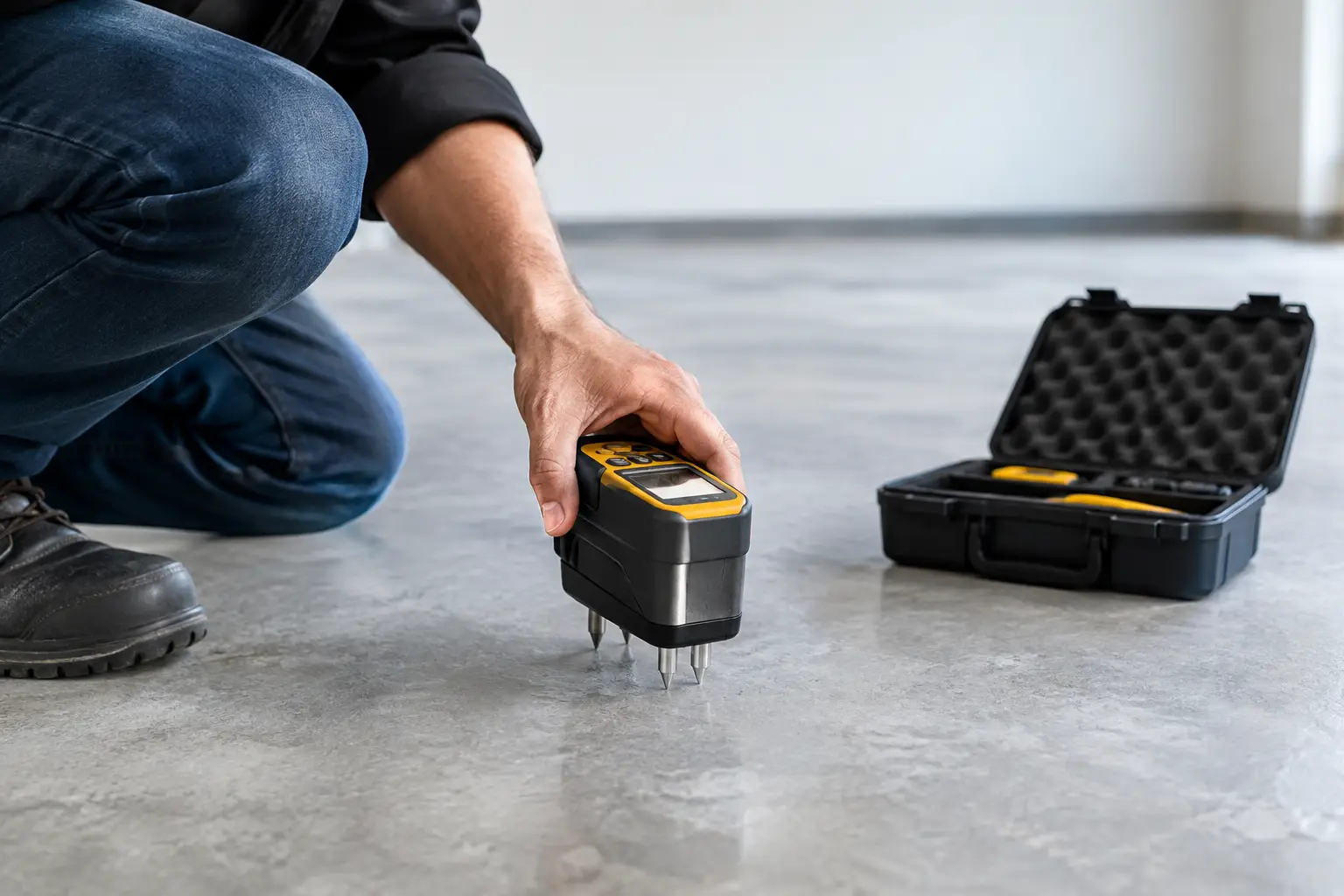
On every project we take on, the first step is a full floor audit — checking for moisture, contamination, cracks, and existing coatings before anything else happens. We then diamond grind to the correct surface profile (CSP 3–4) and carry out moisture vapour emission rate (MVER) testing. Skipping this step is the primary reason cheap epoxy jobs fail within months.
Always ask any epoxy contractor for a written surface preparation plan before work begins. If they can’t provide one, that’s a red flag.
2. Wrong product chosen for the environment
Many property owners — and some contractors — choose the wrong system because they don’t fully understand the difference between product types. The result is a floor that looks fine initially but underperforms or fails under real-world conditions.
Before recommending any product, we assess load requirements, chemical exposure, slip ratings, moisture levels, and what the space actually needs to do. We don’t have a standard package we apply to everything — the specification comes from the site.
3. Hidden costs and quote surprises
Getting wildly different quotes with no clear explanation of what’s included is a common experience for Sydney property owners. Surface preparation, primers, and topcoats are sometimes treated as extras rather than essentials, which is how a quote doubles between acceptance and invoice.
We provide an itemised written quote on every job: surface prep, primer, base coat, topcoat, and any additional items like anti-slip additives or line marking. The number on the quote is the number on the invoice.
Sydney’s Climate and Concrete: What Property Owners Need to Know
Sydney’s combination of humid summers and wet winters creates specific challenges for epoxy floor installations that don’t apply the same way in drier Australian cities. The main issue is moisture vapour emission from concrete slabs.
Moisture vapour emission (MVE): Concrete is not waterproof. Groundwater moves upward through slabs via moisture vapour transmission. In Sydney’s summer humidity, this process accelerates. If epoxy is applied over a slab with a high MVER, trapped moisture causes bubbling, blistering, and coating separation. MVER testing — using a calcium chloride test or relative humidity probe — is the only reliable way to detect this risk before it causes failure.
Most affected suburbs: Lower-lying areas near waterways — including parts of Parramatta, Liverpool, Bankstown, and the Inner West — tend to have slabs with higher moisture content. Pre-1990 homes in these areas often lack adequate damp-proof membranes.
Best installation windows: March to May and September to October offer the most stable conditions: 15–25°C and lower relative humidity. Summer installations are possible but require more intensive moisture management. In Western and elevated Sydney suburbs, winter temperatures can fall below 10°C — worth factoring in, as some epoxy systems won’t cure correctly below this threshold.
Tip: Ask your contractor to provide the MVER test result before coating begins. An application over a slab above 3 lbs/1000 sq ft/24hr will cause bubbling and delamination within months.
Our Epoxy Floor Installation Process
Every Sydney Epoxy Flooring project follows the same sequence. There are no shortcuts.
Floor audit and assessment: We inspect for moisture, cracks, contamination, and structural integrity before recommending any product. This step shapes everything that follows.
Surface preparation: Using diamond grinders and shot blasting equipment, we prepare the substrate to CSP 3–4, the correct surface profile for maximum mechanical adhesion.
Primer application: A penetrating epoxy primer seals the surface and creates the chemical bond needed for long-term performance. This is not a step that can be skipped or combined with the base coat.
Base coat and decorative layer: We apply your chosen system — solid colour, flake, metallic, or quartz — to your specifications.
Topcoat and quality check: A protective polyurethane or epoxy topcoat is applied for UV stability and abrasion resistance. We carry out a full inspection before handover.
How to Maintain Your Epoxy Floor
A professionally installed epoxy floor requires minimal maintenance, but a few simple practices will protect the surface and extend its life significantly.
Day-to-day care
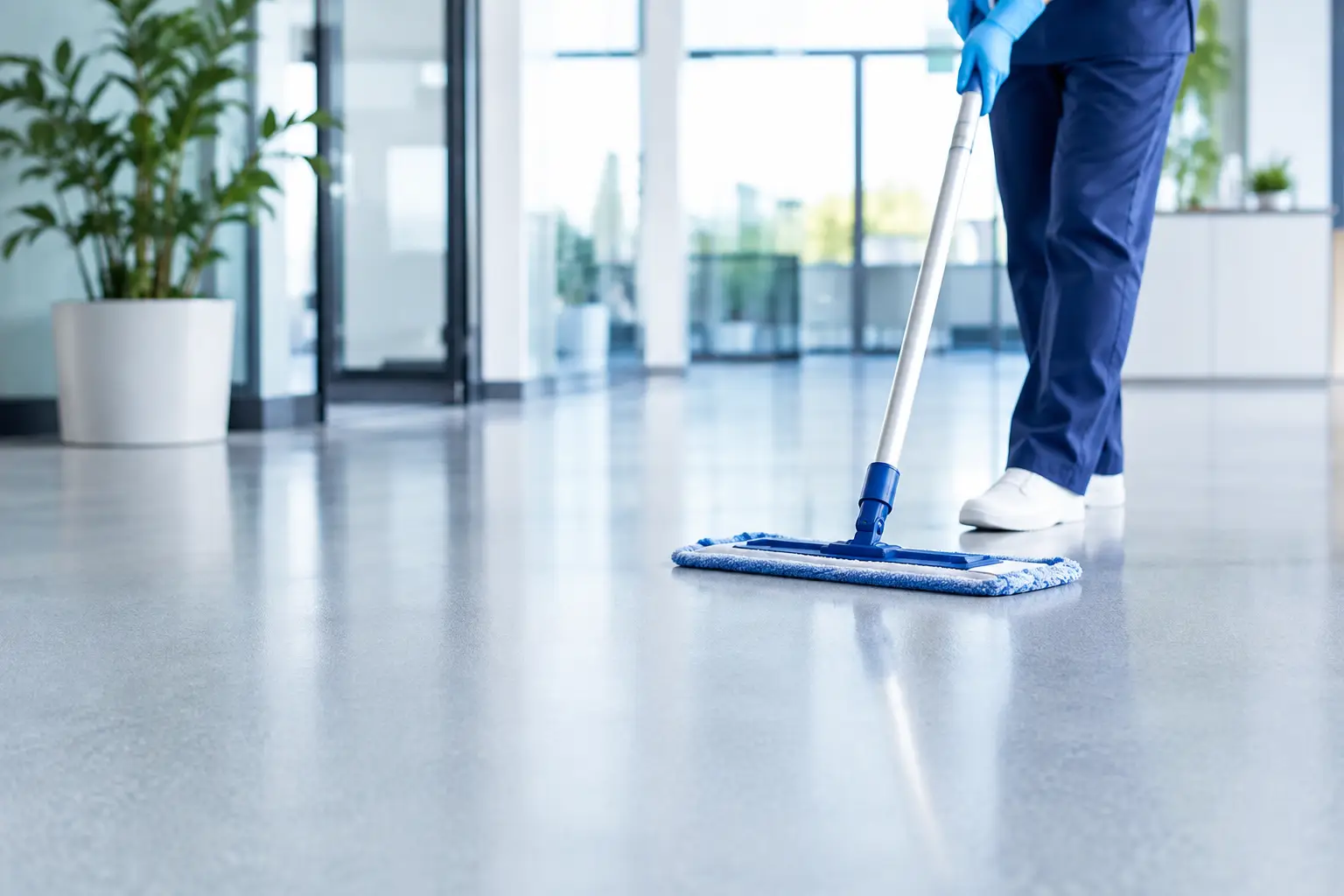
- Sweep with a soft-bristle broom or microfibre mop; fine grit acts like sandpaper and accelerates surface wear over time.
- Use a pH-neutral, non-abrasive cleaner in warm water. Avoid bleach, ammonia-based products, and citrus cleaners; they degrade the topcoat.
- Clean up oil, fuel, or chemical spills immediately. Prolonged exposure to some solvents causes staining or surface softening.
What to avoid
- Steel wool or abrasive cleaning pads
- High-pressure washing at joins or edges
- Dragging heavy metal equipment across the surface
- Standing water on worn or aged areas
When to re-coat
If the surface has lost its sheen, shows widespread minor scratching, or the topcoat has visibly worn down, a topcoat-only renewal is usually all that’s needed. For most commercial environments, topcoat renewal every 7–10 years is a cost-effective way to extend the life of the full system without full removal and reapplication.
Frequently Asked Questions
How long does professional epoxy floor coating last in Sydney?
A properly installed epoxy floor lasts 10–20 years, depending on traffic, maintenance, and the system used. Industrial systems with polyurethane topcoats tend to last longest. The key variable is surface preparation quality at installation — poorly prepared floors fail regardless of the product.
Can you apply epoxy over existing tiles?
In some cases, yes — but the preparation requirements change significantly. Tile adhesion and grout line levelling need to be assessed on-site. We inspect the existing surface and advise on the most practical approach.
How soon can you use the floor after installation?
Most systems allow light foot traffic within 24–48 hours. Full cure for vehicle or heavy machinery use takes 5–7 days, depending on temperature and humidity at the time of installation.
Do you work across all Sydney suburbs?
Yes. We cover all Greater Sydney suburbs. We’re based in Castle Hill and work regularly across the Hills District, Western Sydney, the Inner West, the CBD, and the Northern and Southern suburbs.
Do you carry insurance and comply with Australian standards?
Yes. Sydney Epoxy Flooring carries full public liability insurance and WorkCover coverage on every project. Our work follows AS 3958 standards for industrial and commercial floor coatings. Our in-house team completes every job — we don’t use subcontractors.
How do I get a quote?
Call 1300 621 873, email info@sydepoxyflooring.com.au, or request a free on-site assessment through our website. We respond within one business day.
About Sydney Epoxy Flooring
Sydney Epoxy Flooring is an Australian-owned business based in Castle Hill, NSW. We’ve completed over 2,000 floor projects across residential, commercial, and industrial sites in Sydney — garages, warehouses, hospitals, aged care centres, schools, government buildings, and commercial kitchens.
Our technicians are trained to AS 3958 standards. We carry full public liability insurance and WorkCover on every job. We use our own in-house team on every project — no subcontractors.
What clients say
- “The guys were very professional, friendly and answered all my concerns.” Vishwa Nand ★★★★★
- “Really nice floor. Amir did an awesome job and explained a lot of techniques.” Aimee Shen ★★★★★
- “The whole experience was smooth, professional and pleasant.” Paul Mirabelle ★★★★★
149+ verified Google reviews | 1,000+ completed projects | Castle Hill, NSW
Contact Sydney Epoxy Flooring Experts:
Phone: 1300 621 873
Email: info@sydepoxyflooring.com.au
Address: Unit 123/7 Hoyle Ave, Castle Hill, NSW 2154
Follow Us on Social Media: