A new epoxy floor can look exceptional on installation day, then begin to peel at tire paths, doorways, or busy work zones months later. In many cases, the coating itself is not the problem. Concrete grinding before epoxy is what determines whether the resin bonds to a sound, open concrete surface or sits on dust, contaminants, and weak material that cannot support it.
For a garage, warehouse, commercial kitchen, workshop, or car park, preparation is not an optional add-on. It is the foundation of a floor that performs as specified. The right grinding process removes surface defects, creates the required texture, and gives the coating system a reliable mechanical bond.
Why concrete grinding before epoxy matters
Concrete may look solid, but its uppermost layer is often the least dependable part of the slab. New concrete can have a dense, smooth finish known as laitance. Older slabs may carry paint, sealers, curing compounds, tire residue, oil, adhesives, or ingrained dirt. A coating applied over these materials is only as strong as the material beneath it.
Grinding removes that compromised layer and exposes clean, sound concrete. More importantly, it creates a controlled surface profile. Epoxy flows into the fine peaks and valleys left by diamond tooling, then cures into those irregularities. This mechanical bond is a major reason a professionally prepared epoxy floor resists peeling and delamination under traffic, impacts, cleaning, and temperature changes.
Surface preparation also makes hidden issues visible. Once old coatings and contamination are removed, an installer can identify cracks, spalls, weak patches, previous repairs, and areas affected by moisture. Addressing these conditions before the epoxy is applied is far more effective than trying to disguise them under a finish coat.
Grinding is not simply making concrete rough
A floor should not be ground aggressively just for the sake of creating a rough texture. The required profile depends on the coating system, the condition of the slab, and how the finished space will be used.
A thin-film epoxy coating may require a lighter, more uniform profile than a thick build system or decorative flake floor. A heavily contaminated workshop floor may need multiple grinding passes and targeted degreasing. A commercial kitchen may require repairs, coving details, waterproofing coordination, and a resin system selected for hot washdowns and food-service conditions. In industrial areas exposed to chemicals or thermal shock, polyurethane cement may be more appropriate than conventional epoxy.
The goal is a clean, stable substrate with enough profile for the specified primer and coating to anchor properly. Flooring contractors commonly describe this texture using Concrete Surface Profile, or CSP. Many epoxy systems perform well on a light-to-medium profile, but the product manufacturer’s requirements and the project specification should guide the final preparation method.
What a professional grinding process involves
The process starts before a grinder reaches the floor. A proper site assessment considers the concrete’s age, strength, flatness, contamination, previous coatings, cracks, joints, and moisture risk. It also considers the operating environment. A decorative residential garage has different requirements from a warehouse with forklift traffic or a production area requiring line marking and slip resistance.
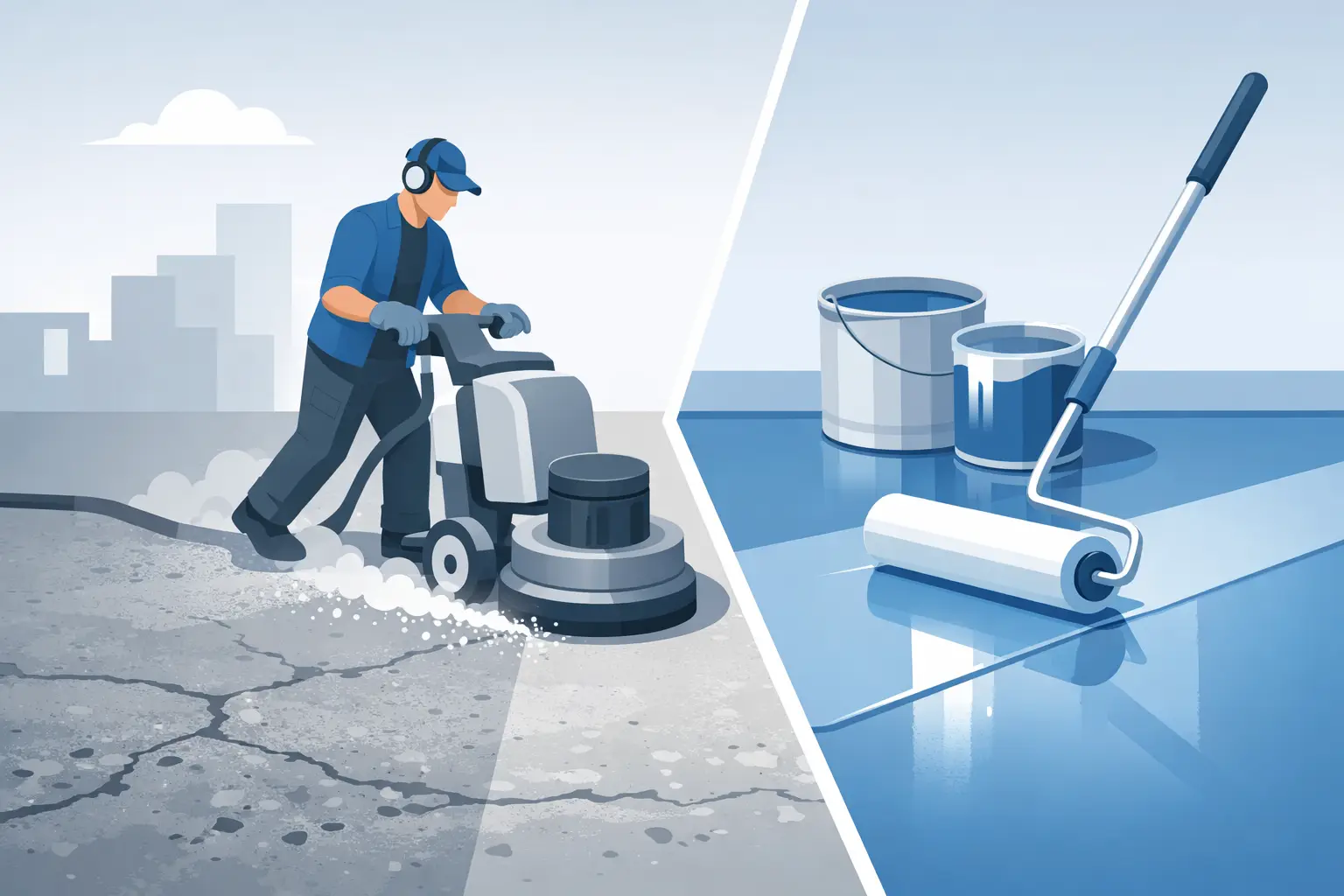
After the assessment, installers select diamond tooling suited to the slab. Hard concrete may need a different diamond bond than soft or abrasive concrete. The machine size and grinding pattern are also selected around access, edges, floor layout, and the amount of material that needs to be removed. Large planetary grinders create a consistent finish across open areas, while hand grinders reach walls, columns, corners, and equipment bases.
Professional equipment should be connected to industrial dust extraction. Concrete dust is not merely a cleaning inconvenience. It can affect adjacent operations, create a safety concern, and settle back onto the prepared substrate. Dust-controlled grinding keeps the work area cleaner and allows the installer to inspect the actual concrete surface as preparation progresses.
Once grinding is complete, the floor is thoroughly vacuumed. Remaining contaminants are treated, cracks and spalls are repaired with compatible materials, and joints are evaluated according to the floor’s intended movement and coating design. The surface must be clean and dry before primer application. Skipping the final cleaning stage can undermine otherwise careful grinding work.
Moisture testing belongs in the preparation plan
Grinding improves adhesion, but it does not solve excessive moisture vapor moving through a concrete slab. Moisture is one of the most common causes of blistering, bubbling, and bond loss in resin flooring. This is especially relevant for slabs on grade, older buildings with uncertain vapor barriers, spaces with drainage problems, and areas that have recently been cleaned or exposed to water.
Depending on the project, moisture testing may include relative humidity testing within the slab, calcium chloride testing, or a review of site conditions and drainage. The appropriate method depends on the coating manufacturer’s system requirements. If moisture levels exceed acceptable limits, a moisture-mitigation primer or another specified solution may be needed before the epoxy system is installed.
This is an area where cost-cutting often creates expensive repairs. Applying epoxy to a slab with an unresolved moisture condition can produce a floor that appears acceptable at first, only to fail after curing or seasonal changes. A reliable scope allows time for testing and provides a clear response if the results require additional work.
Common shortcuts that lead to epoxy failure
Acid etching is sometimes presented as an alternative to grinding. While it may have limited use in specific situations, it is not a substitute for mechanical preparation on many professional projects. Acid does not reliably remove heavy coatings, oil contamination, weak concrete, or dense surface layers. It also creates a wastewater-management issue and requires complete neutralization and drying. If residue remains, the coating bond can be compromised.
Another shortcut is applying epoxy after only pressure washing or sweeping. Water cleaning may remove loose soil, but it will not create the surface profile needed for a durable mechanical bond. It can also push contaminants deeper into porous concrete or add moisture to the slab.
Spot grinding can be appropriate for localized repairs, but it is not enough where the entire floor has a sealer, old coating, or inconsistent surface condition. An epoxy floor should be prepared consistently across the installation area, including edges and transitions. These details are often where early peeling begins.
How grinding supports the finished floor
The quality of preparation affects more than adhesion. It also influences appearance, safety, and maintenance. A uniformly prepared substrate helps primers wet out evenly, which supports consistent color and gloss in a solid-color epoxy system. For decorative flake or metallic finishes, careful preparation reduces the risk that cracks, old coating edges, or substrate variations telegraph through the completed floor.
Grinding also allows repairs to be integrated before the decorative layers are applied. Cracks can be chased, filled, and ground flush where appropriate. Spalled concrete can be rebuilt. Uneven areas can be assessed for patching or leveling. Not every crack should be rigidly filled, however. Active joints and moving cracks need a solution that accounts for movement rather than simply covering them with a brittle coating.
In workplaces, preparation supports performance requirements that matter every day: a floor that remains easier to clean, accommodates designated walkways and line marking, and provides the selected slip-resistant finish without sacrificing durability. The coating system should be designed around the risk profile of the space, not chosen from a color chart alone.
When to schedule the work
Grinding and epoxy application should be coordinated with site operations. In an occupied warehouse, retail site, or commercial facility, the work may need to be staged to maintain access and reduce disruption. Equipment should be moved, floor drains protected where required, and curing time allowed before traffic returns.
Temperature and humidity also affect resin application and cure times. The concrete must meet the coating system’s environmental requirements, and the installation team should account for conditions in enclosed spaces, open loading areas, and sites with limited ventilation. Rushing a return to service can damage a coating before it reaches its intended performance level.
Sydney Epoxy Flooring approaches preparation as part of the full flooring system: inspect the slab, define the required repairs and profile, select the compatible primer and resin, then verify the finished floor before handover. That process gives owners and facilities teams a clearer scope, fewer surprises, and a floor suited to actual service conditions.
A durable epoxy floor begins with the concrete that is already there. When grinding, repairs, moisture evaluation, and cleaning are handled with the same care as the final coat, the result is not just a better-looking surface – it is a floor ready to earn its keep.