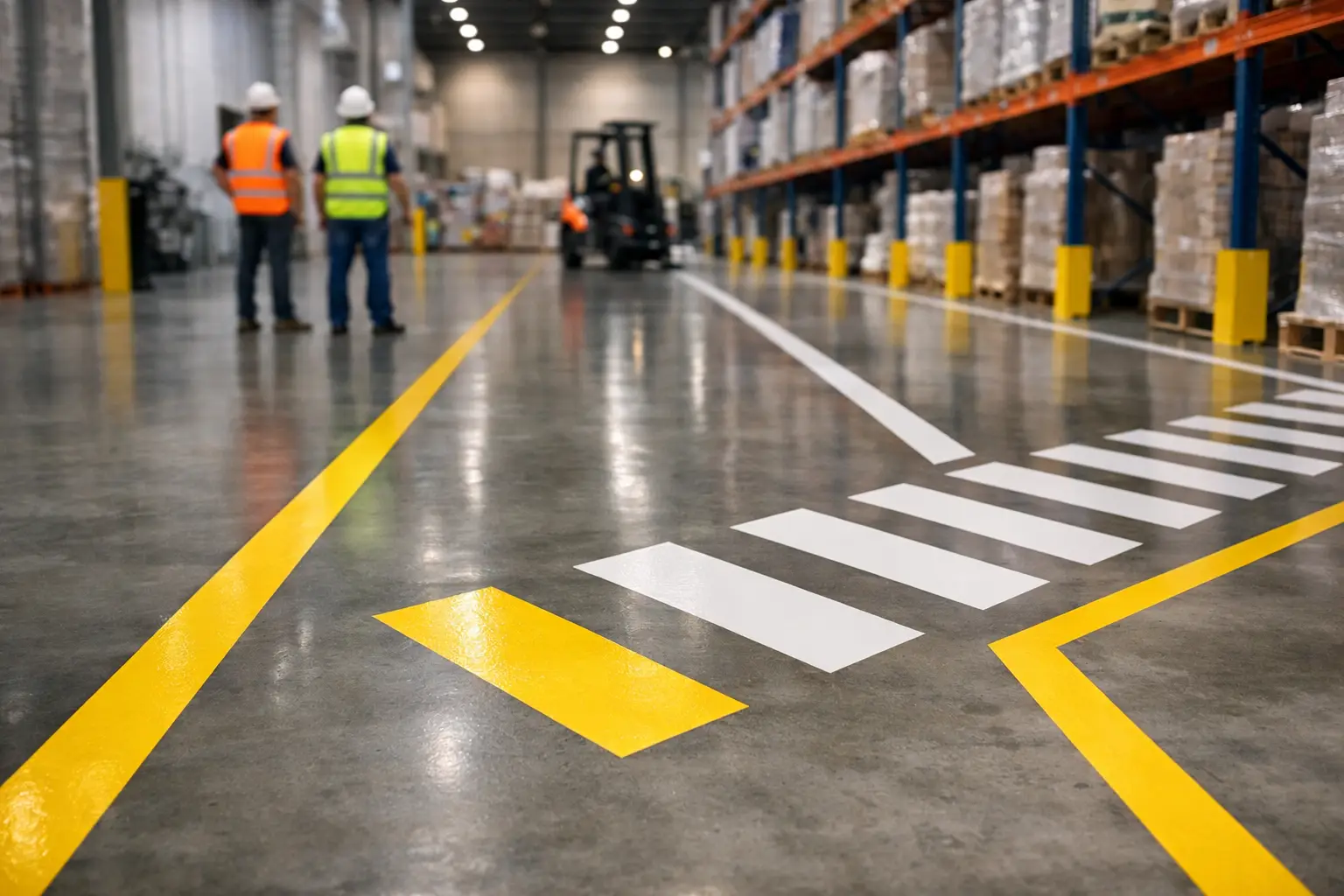
A warehouse can have good racking, capable staff, and efficient equipment, yet still lose time and create risk when people and forklifts are left to interpret the floor. Professional warehouse line marking Sydney facilities can rely on turns open concrete into a clear operating plan: where vehicles travel, where people walk, where goods wait, and where access must remain clear.
The paint itself is only one part of the job. Effective marking starts with how the building actually operates, then uses the right materials, layout, preparation, and installation sequence to keep that plan visible under daily traffic.
Why warehouse line marking matters
Floor markings reduce uncertainty in places where uncertainty causes delays. A defined forklift lane helps operators make predictable movements. A clearly separated pedestrian route gives staff and visitors a safer way through active areas. Marked staging bays stop temporary storage from spreading into aisles, fire exits, loading zones, or electrical access.
This is not simply about making a warehouse look organized. It supports safer traffic flow, more consistent housekeeping, and quicker decisions during busy periods. For facilities managers, it also makes site rules easier to communicate and reinforce. New team members can see the intended layout rather than relying solely on verbal instruction.
The right solution depends on the warehouse. A high-turnover dispatch facility needs durable lanes and loading-zone boundaries that stand up to constant vehicle movement. A manufacturing warehouse may need to separate raw materials, work-in-progress, finished goods, and maintenance areas. A smaller workshop may benefit most from simple vehicle routes, exclusion zones, and clearly marked storage locations.
Start with the way your facility moves
Before marking begins, assess traffic patterns rather than drawing lines around the current clutter. Review entry and exit points, racking aisles, blind corners, loading docks, battery charging areas, emergency equipment, pedestrian doors, and regularly used workstations. Speak with the people who operate forklifts and manage dispatch. They often identify bottlenecks that are not obvious on a floor plan.
A practical layout considers turning circles, sightlines, and peak activity. For example, a pedestrian path placed directly beside a busy loading lane may be technically visible but still poorly positioned. In some cases, physical barriers, guardrails, or changes to material staging are needed alongside floor markings. Line marking is highly effective, but it should support a broader site-safety approach rather than carry the whole burden on its own.
It also pays to decide which areas need permanent control and which need flexibility. Fixed forklift routes, emergency accessways, and exclusion zones generally require long-lasting markings. Seasonal overflow storage or changing pick areas may be better managed with a layout that can be updated without disrupting the entire floor.
Areas that typically benefit from clear marking
Most warehouse projects include a tailored combination of the following:
- Forklift lanes, directional arrows, intersections, and stop points
- Pedestrian walkways, crossings, and no-go zones
- Loading, dispatch, receiving, and pallet staging areas
- Racking boundaries, keep-clear accessways, and inspection zones
- Fire equipment, electrical panels, first-aid points, and emergency exits
Color selection should make these zones easy to distinguish at a glance. Yellow is often used for general traffic and caution areas, while white can define storage or operational boundaries. Red commonly identifies fire-related equipment or restricted areas. The exact color plan should align with your site procedures and any applicable safety requirements, not just a generic warehouse template.
Surface preparation determines marking life
The most common reason line marking fails early is not the choice of color. It is inadequate preparation. Warehouse slabs collect tire residue, dust, oil, old coating, moisture, and contaminants that can prevent a new coating from bonding properly. Applying paint over a poorly prepared surface may look acceptable at handover, then lift, wear, or peel once forklifts begin crossing it.
A professional assessment checks the condition of the concrete and any existing coating before recommending a system. Mechanical grinding or abrasion may be required to create a sound profile for adhesion. Cracks, spalls, and uneven areas should be repaired where they affect performance or line quality. The floor must also be cleaned and dry before application.
Preparation requirements vary. A clean epoxy-coated warehouse floor may need localized abrasion and careful cleaning before re-marking. An older, uncoated slab with embedded grime may require more extensive grinding. Where moisture is present, the coating specification may need to change. Taking the time to establish these conditions protects the investment and avoids a patchwork result.
Choose materials for traffic, not just appearance
Warehouse line marking products range from standard traffic paints to high-build epoxy and fast-curing MMA systems. Each has a place, and the best choice comes down to use, downtime limits, and the existing floor.
Epoxy line marking is a strong option for many industrial facilities because it provides good adhesion, abrasion resistance, and chemical resistance when correctly installed over a prepared substrate. It is particularly suitable where the markings need to integrate with an epoxy floor coating or where durable, cleanable lines are the priority.
Polyurethane-based systems can be worth considering where the floor experiences thermal movement, impacts, or specific chemical exposure. In food production and demanding washdown environments, polyurethane cement may be more appropriate as part of the wider floor system. For facilities that cannot tolerate extended closures, MMA can offer fast curing, although its installation requires careful planning due to odor and application conditions.
There is always a trade-off. A lower-cost paint may be suitable for light traffic or short-term layout changes, but it is unlikely to perform like a properly prepared resin system beneath loaded forklifts. A premium system costs more upfront, yet can reduce the frequency of touch-ups and the disruption that comes with repeated closures.
Plan installation around warehouse operations
A good marking program should improve operations, not interrupt them unnecessarily. This is why project planning matters as much as application. The work may be staged by aisle, zone, or shift, allowing parts of the warehouse to remain active while others are prepared and marked.
The installation sequence typically includes a site inspection, an agreed layout, surface preparation, repairs where needed, priming, line application, curing, and a final inspection. Curing time must be respected. Reopening the area too early can mark the surface, reduce adhesion, or create premature wear, especially in high-load forklift zones.
Clear communication is essential before work starts. Staff need to know which areas are closed, alternative travel routes, and when equipment can return. Pallets, racks, and machinery may need to be moved temporarily. Sydney Epoxy Flooring plans these details with clients so the scope, materials, timing, and expected access restrictions are understood before the project begins.
Keep markings useful after installation
Even durable line markings need routine attention. Sweeping grit and debris limits abrasive wear, while prompt cleaning of oil or chemical spills helps preserve the surrounding floor and keeps colors visible. If forklifts repeatedly cut corners or pallets are dragged across one boundary, the issue may be operational rather than material-related. Adjusting the traffic pattern can protect the markings more effectively than simply repainting them.
Periodic inspections are worthwhile, particularly around dock doors, intersections, battery stations, and main travel lanes. Faded lines, obscured arrows, and storage that has crept beyond marked bays are early signs that the layout needs attention. Re-marking selected high-wear areas is often more efficient than waiting until the entire system becomes unclear.
A floor layout people can follow
The best warehouse markings do not demand attention because they make the correct action obvious. They help a forklift operator choose the right route, show a visitor where to walk, and keep essential access clear when the facility is under pressure. With a layout built around real operations and coatings selected for the conditions, the floor becomes a dependable part of how the warehouse works every day.
If your current lines are fading, peeling, or no longer match the way your site operates, treat that as an opportunity to reassess the full traffic plan rather than simply repainting what is already there.