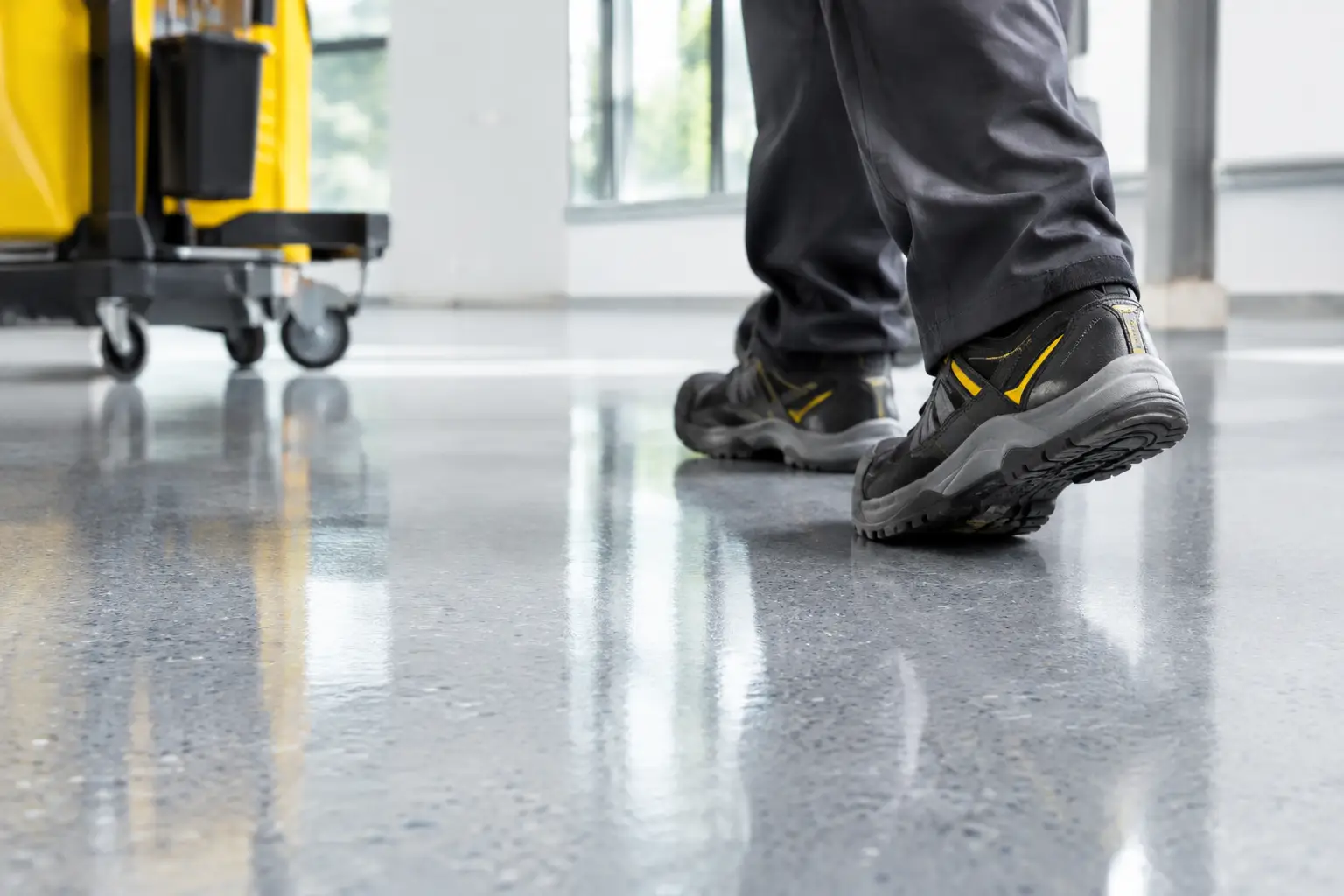
A warehouse floor can look clean and still create daily risk. When pedestrian routes fade, pallet staging areas drift, and forklift traffic crosses without clear separation, people are left to make judgment calls in active work zones. Epoxy floor line marking gives those areas a durable visual structure, helping teams move, store, load, and work with greater consistency.
For facilities managers, builders, and operations leaders, line marking is not a cosmetic add-on applied at the end of a project. It is part of the floor system. The right layout, coating specification, surface preparation, and curing plan determine whether markings stay sharp under traffic or start peeling after a few busy months.
What epoxy floor line marking is designed to do
Epoxy line marking uses high-build resin coatings to create visible boundaries, traffic lanes, safety zones, work cells, and storage locations directly on a prepared concrete or resin floor. Unlike basic paint, a properly specified epoxy system bonds to the substrate or existing compatible coating, forming a hard-wearing finish that stands up to wheeled traffic, cleaning routines, and many workplace contaminants.
In an industrial setting, markings may separate forklifts from foot traffic, define loading and dispatch lanes, identify pedestrian crossings, or reserve locations for materials and equipment. In workshops, they can outline machine clearance areas, inspection bays, and safe walkways. Commercial kitchens and food production areas often use markings to support orderly workflow while maintaining a cleanable, hygienic surface.
The value is practical: employees and visitors can see where they should be, supervisors can reinforce consistent processes, and facilities gain a more organized visual standard. That said, lines alone do not make a workplace compliant. Their design should support the site’s broader traffic management plan, safety procedures, signage, and operational requirements.
Start with the floor, not the paint
The most common reason floor lines fail is not the line-marking material itself. It is inadequate preparation. Concrete can hold dust, moisture, oil, curing compounds, old coatings, and contaminants that prevent reliable adhesion. A smooth-looking slab may also have weak surface laitance that needs to be removed before any resin is applied.
A professional assessment considers the concrete condition, existing floor finish, traffic type, exposure to chemicals, moisture levels, and available shutdown time. This matters because a light-duty storeroom and a high-traffic warehouse need different preparation and coating systems.
Mechanical grinding is often used to open the concrete surface and create a suitable profile for bonding. Cracks, joints, chips, and localized damage should be assessed and repaired before markings are installed. If the base epoxy floor is failing, applying crisp new lines over it will not solve the underlying issue. In many cases, the better long-term decision is to repair or recoat the broader floor first, then add markings as part of the final system.
Plan the layout around actual movement
Good line marking starts with observation. A layout copied from a generic plan can conflict with the way a facility really operates. Before setting out lines, consider how people, forklifts, trolleys, stock, waste, and deliveries move through the space at peak periods.
Pedestrian routes need logical entry and exit points, clear crossings, and enough width for the expected traffic. Forklift lanes should account for turning circles, rack access, loading zones, and sightlines near doors or intersections. Storage bays need to be large enough for the items they are meant to contain, including clearance for handling equipment.
Color selection should also be deliberate. Yellow is commonly used for caution areas, pathways, and general separation, while white can define storage or operational areas. Red may indicate fire equipment or prohibited zones, and blue or green may support site-specific functions. The exact meaning should be consistent throughout the facility and align with the organization’s internal safety system.
Text, arrows, numbers, and symbols can be incorporated where they genuinely improve clarity. However, overcrowding the floor with too many instructions can have the opposite effect. The strongest layouts are easy to read at a glance, especially from a forklift seat or while carrying materials.
Width and visibility matter
A line that is technically present but difficult to see does little for safety. Width should reflect the purpose of the marking, the viewing distance, lighting conditions, and the speed of nearby traffic. Narrow lines may suit low-traffic work cells, while vehicle lanes and pedestrian boundaries generally need a stronger visual presence.
Contrast is equally important. Light-colored lines can disappear against pale concrete, while dark lines can be lost on a charcoal epoxy floor. During the specification stage, assess the floor color and lighting together. A high-contrast finish is usually more useful than a color choice based on appearance alone.
Choosing the right coating system
Epoxy is a strong choice for many indoor commercial and industrial environments because it provides adhesion, wear resistance, and a clean, professional finish. It performs particularly well where floors need to tolerate routine traffic, abrasion, and moderate chemical exposure.
But epoxy is not the answer to every condition. Areas exposed to sustained UV light may benefit from a UV-stable topcoat to reduce yellowing or color change. Wet areas, ramps, and spaces where slip resistance is critical may require an aggregate broadcast or a textured finish that works with the line-marking design. Facilities exposed to thermal shock, aggressive cleaning, hot washdowns, or heavy chemical use may be better served by polyurethane cement or another specialist resin system.
Cure time is another operational consideration. Standard epoxy systems require a planned installation window and sufficient curing before traffic returns. Where shutdown time is extremely limited, methyl methacrylate, or MMA, systems may be considered because they can cure faster. The trade-off is that MMA installation requires careful planning, ventilation, and experienced application due to its strong odor and fast working time.
The right recommendation depends on the environment, not a one-size-fits-all product preference. A detailed floor audit avoids costly decisions based solely on upfront price.
The application process that protects the result
Once the floor is prepared and the layout is approved, accuracy becomes essential. Lines should be measured, snapped, and masked cleanly so edges remain straight and consistent. Poor masking, uneven widths, and inconsistent spacing are immediately visible on a finished floor, particularly in customer-facing workshops, showrooms, and parking facilities.
The installer then applies the selected epoxy or resin coating at the required film build. Depending on the system, this may involve a primer, body coat, colored marking coat, and protective topcoat. If anti-slip performance is required, the texture must be balanced carefully. Too little aggregate may not provide adequate grip, while too much can create a surface that is harder to clean or uncomfortable for wheeled equipment.
Curing should be treated as part of the installation, not as idle time after it. Foot traffic, forklifts, pallet jacks, cleaning chemicals, and heavy equipment should stay off the marked area until the system reaches its specified cure stage. Reopening too early can leave tire marks, scuffs, or permanent damage in an otherwise well-installed finish.
At Sydney Epoxy Flooring, this process is managed from site inspection through preparation, application, curing, and final inspection. That approach helps ensure the marking system suits the real demands of the floor rather than simply looking good on handover day.
Maintaining marked floors without wearing them out
Epoxy line markings are low-maintenance, but they are not maintenance-free. Regular sweeping prevents abrasive grit from acting like sandpaper under forklift tires. Prompt cleanup of oils, chemicals, and spills reduces staining and helps preserve the finish. Cleaning products should be compatible with the resin system, particularly in facilities that use degreasers or automated scrubbers.
Inspect high-wear locations periodically, including turning points, loading bays, doorways, and areas beneath regularly moved equipment. These are often the first locations to show abrasion. Localized repairs can usually restore visibility before damage spreads, but the repair area must be prepared properly to achieve a sound bond.
When operations change, revisit the line-marking plan rather than layering new lines over old ones. Removing obsolete markings and updating the layout keeps the floor understandable. A clear system is safer than a floor covered in conflicting colors and abandoned boundaries.
A well-planned marked floor gives people clear cues without interrupting their work. If your site has growing traffic, changing storage demands, or fading safety zones, begin with a floor assessment and a layout built around how the space is actually used.